
Chaplet of St Michael
Chaplet of st Michael
A quiet guide for Catholics who wish to welcome the Chaplet of St Michael into daily prayer, home life, and ordinary moments of trust.
The Chaplet of St Michael is a simple set of beads that helps many Catholics grow closer to the holy angels in an ordered, peaceful way. It is not a magic object, and it does not replace the sacraments or the life of the Church. It is simply a tool for prayer, a way to gently focus the mind and heart on God, asking for help through the intercession of St Michael and the choirs of angels.
In my own life, the Chaplet of St Michael became part of my routine during a season when worries about my family and the world felt heavy. I did not experience anything dramatic, but I noticed that taking ten or fifteen quiet minutes with this chaplet in my hands helped me breathe, slow down, and place those concerns before God with more trust. Over time, it became a familiar rhythm that I now return to often, especially at the end of the day.
If you are considering using a Chaplet of St Michael, you do not need to be an expert in prayers to the angels. You do not have to feel especially holy or knowledgeable. Many ordinary Catholics simply pick up the chaplet, learn the structure step by step, and let it shape a steady, humble way of asking for protection and guidance in everyday life.

This page contains affiliate links. If you click and buy, I may earn a commission at no extra cost to you.
Let me look closerWhat the Chaplet of St Michael really is
A Chaplet of St Michael is a structured way to pray in honor of St Michael the Archangel and the nine choirs of angels. It usually has a medal of St Michael connected to beads arranged in a specific pattern. Each group of beads guides you through set prayers, so you are not left wondering what to say next. The beads simply keep your place while your heart turns quietly toward God.
Historically, devotion to St Michael has been strong in the Church for many centuries, especially in times when people felt aware of spiritual struggle and the need for protection. If you look up Saint Michael the Archangel, you can see how Christians across cultures have turned to him as a guardian in battle, a defender of the Church, and a helper at the hour of death. The chaplet flows gently out of that long tradition.
For many of us, this chaplet fits alongside the Rosary, morning prayers, or quiet time with Scripture. Some pray it daily, others only on certain days of the week, and some keep it for particular intentions, such as praying for children, for the Church, or for peace during anxious seasons. There is no single “right” schedule; what matters most is sincerity and steadiness.
I remember one autumn when I began praying the Chaplet of St Michael in my car before walking into work. The parking lot was actually one of the few quiet places I had. Holding the chaplet and moving bead by bead slowly became a small ritual of handing the workday to God, asking that every conversation and decision would be carried out under His care. Nothing in my job changed overnight, but that small act helped me walk through the doors with less tension.
How the Chaplet of St Michael fits into daily Catholic life
Because the Chaplet of St Michael is fairly short compared with a full Rosary, it can slip naturally into ordinary routines without feeling overwhelming. Some Catholics prefer to pray it:
- In the early morning, before the house is fully awake
- During a lunch break, perhaps in a quiet corner or parked car
- In the evening, as part of winding down from the day
- On Fridays or during particular liturgical seasons, like Lent
- Whenever they feel the need to entrust a heavy concern to God
Unlike more spontaneous prayer, the chaplet gives you a clear structure to follow. That can be a relief when your mind is tired or distracted. The familiar words gradually become like a steady background melody, allowing your heart to place specific needs—your family, your parish, your country—quietly before the Lord.
One simple way to begin is to keep your Chaplet of St Michael in a place where you naturally pause: on the nightstand, in a purse, on a home altar, or even gently tucked into a coat pocket. When you see it, let it remind you to take a few focused minutes of prayer. I have often left my chaplet on the kitchen counter; after dinner, before dishes, I sometimes pause, pick it up, and at least pray a portion, even if I cannot finish the whole chaplet at once.
Looking more closely at a physical Chaplet of St Michael
While the prayers are central, the physical chaplet also matters. It is something you hold, see, and sometimes carry with you. The material, medals, and design can gently shape how you experience the devotion. Some chaplets are very simple and modest; others include more detailed medals or colors to honor the angels.
Over time, a particular chaplet can become familiar, like an old friend. The beads might warm slightly from your hands. The medal may show a bit of wear. These small signs of use are not imperfections; they are reminders that prayer has been offered through many ordinary days, joys, and worries.



Using the Chaplet of St Michael with intention and peace
When you first pick up the Chaplet of St Michael, it can be helpful to approach it slowly. You do not need to rush through the prayers or force a particular feeling. Many Catholics find it more fruitful to:
- Begin with a simple, honest intention in their own words
- Pray at a pace that allows the words to be understood
- Pause briefly between each group of beads to recollect
- Accept distraction without guilt, gently returning to the words
- Offer the chaplet even when they feel dry or tired
For me, the most helpful approach has been to treat the chaplet as a steady walk rather than a sprint. On some days, I can pray it with clear focus; on others, my thoughts wander. I try not to measure the “quality” of my prayer. Simply being there before God, asking for the help of St Michael and the angels, is already a step of trust.
I remember a late-night drive when I felt especially uneasy about a difficult situation. I had my Chaplet of St Michael in the car’s center console. At a long red light, I reached for it almost without thinking and began the prayers. The problem did not disappear, but my heart felt less alone. The chaplet became a way of saying, “Lord, I cannot fix this, but I place it in Your hands,” with St Michael and the angels standing with me in that prayer.
It is important to avoid treating the chaplet as a kind of spiritual formula that forces God to act. Our faith is not built on techniques. Instead, the chaplet is one more humble path for turning our attention toward God, recognizing that the angels are part of His providence and care for us.
Common features you may notice in Chaplet of St Michael designs
When you look at different versions of the Chaplet of St Michael, you may notice certain recurring elements. These are not requirements, but they are typical and can shape how the chaplet feels in your hands and fits into daily life.
Medal of St Michael
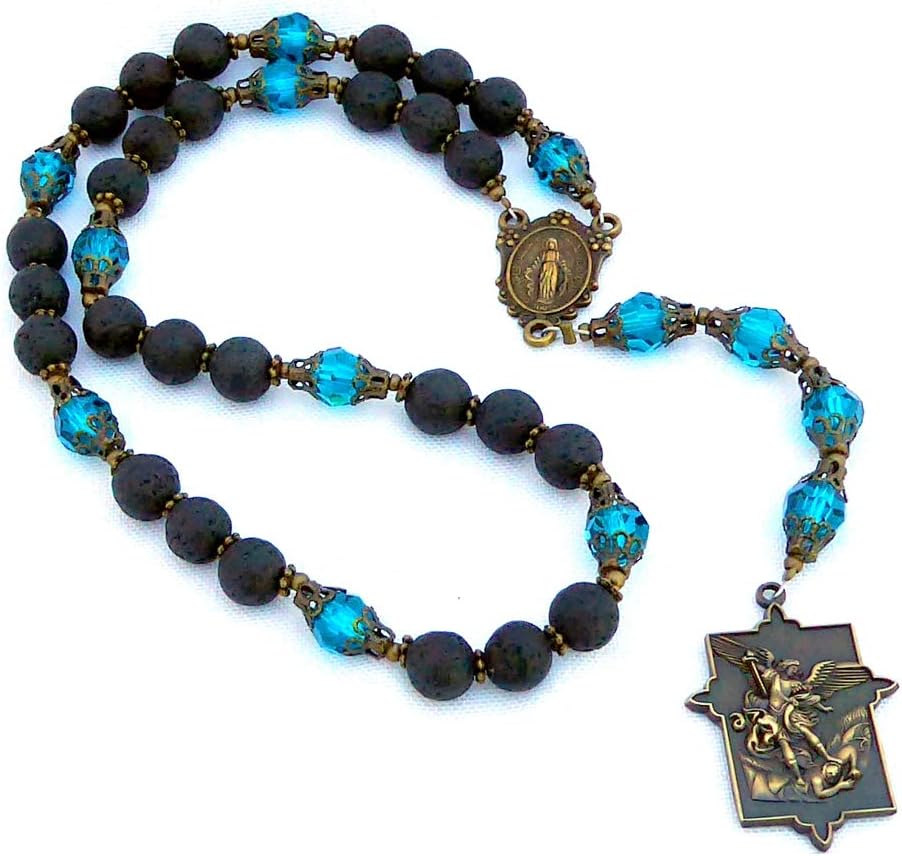
Most chaplets include a medal of St Michael, often showing him as a warrior standing over a dragon or evil figure. This image is meant to reflect the biblical picture of St Michael as a defender and protector. Over time, seeing and touching this medal can remind you to turn to God with courage when life feels like a battle.
Shape, weight, and materials
Some Chaplets of St Michael are made with lightweight plastic beads; others use glass, stone, or metal. A lighter chaplet may be easier to carry in a pocket or purse. Heavier beads can feel more solid and grounding in your hand. Neither is better in a spiritual sense; it often comes down to what helps you pray with focus and calm.
The color of the beads can also gently influence how you experience the chaplet. Blue, clear, or dark tones are common. Some people prefer more subdued colors that blend into everyday life; others enjoy designs that stand out a bit more on a prayer table or nightstand.



Bringing the Chaplet of St Michael into your home
Many Catholics like to give the Chaplet of St Michael a stable place in the home, even if they also carry it with them. This can help family members remember that the house itself is entrusted to God’s protection and care.
A chaplet can rest on:
- A small home prayer corner with a crucifix and a Bible
- A bedroom nightstand, close to where the day begins and ends
- A quiet shelf in the living room, near a statue or holy picture
- A simple wall hook next to a door, as a reminder when leaving or returning
In my own home, I keep the Chaplet of St Michael in a small wooden bowl next to a candle and an image of the Holy Family. When we have guests over, some do not even notice; others ask quietly about it. The chaplet becomes a silent witness to faith, without pressure or explanation, simply present as part of the ordinary landscape of daily life.
When children or grandchildren see the chaplet, they may become curious. Some families gently introduce the prayers, one part at a time, without forcing or rushing. Others simply let the children watch and learn over the years. There is something beautiful in letting the next generation see that prayer is part of the home in a calm, natural way.
Chaplet of St Michael – Questions and Answers
1. Is the Chaplet of St Michael only for very devout or knowledgeable Catholics?
No. The Chaplet of St Michael is often prayed by ordinary Catholics who simply want a concrete way to ask for help from God through St Michael and the angels. You do not need special knowledge or strong feelings. A humble desire to pray, even imperfectly, is enough to begin.
2. Does praying the Chaplet of St Michael guarantee protection or special favors?
The Church does not treat this chaplet as a guarantee of particular results. It is a way of prayer, not a contract. We trust that God listens to all sincere prayer, but how He answers is His loving decision. The chaplet helps us turn to Him and to the angels with confidence and humility, without demanding specific outcomes.
3. How often should I pray the Chaplet of St Michael?
There is no strict rule. Some Catholics pray it daily, others once a week, and some only during difficult times or certain seasons. You might start with once a week and see how it fits into your life. The most important thing is to pray with sincerity, not to meet a quota.
4. Can I pray the chaplet even if I do not feel particularly “spiritual”?
Yes. Many of us pray when we are tired, distracted, or emotionally flat. Feelings come and go, but prayer is an act of trust more than an experience. Holding the Chaplet of St Michael and offering the words, even in dryness, can be a quiet way of saying, “Lord, I am here. Please be with me,” and that simple faith has real value.
5. Is it better to have a physical Chaplet of St Michael, or can I pray it without beads?
You can certainly pray the chaplet without beads, counting on your fingers or following a printed guide. A physical chaplet is helpful because it gives your hands something to hold, which can calm the mind and keep track of the prayers. Many people find that the texture of the beads and the weight of the medal draw them into a more focused, reverent frame of mind, but it is not absolutely required.
Quietly choosing a Chaplet of St Michael
When you consider a Chaplet of St Michael, it can help to think less about appearance and more about how you hope to use it. Ask yourself simple questions: Will I carry it with me or keep it mostly at home? Do I prefer lighter or heavier beads in my hand? Do I want a design that is discreet or one that stands out on a prayer table?
Over time, the chaplet you choose may become closely linked with certain memories—late-night prayers for a sick relative, early-morning intercession for your parish, whispered petitions for a child who has drifted from the faith. These memories can quietly anchor your heart, reminding you that God has walked with you through many chapters, even when you did not notice it clearly in the moment.
However you decide, a Chaplet of St Michael can be a small, steady companion in the life of faith, encouraging you to remember that you are not alone. The angels belong to God, and we trust that He sends their help according to His wisdom and love.
If you would like to look more closely at different chaplet designs and find one that fits naturally into your own way of praying, you can explore them quietly online.
Show me the options